ETHIOPIA
The horse populations of Ethiopia
Ethiopia has one of the largest equine populations in Africa and a long history of horse ownership associated with agriculture, transport, warfare and ceremonial life. Unlike countries where horse breeding has concentrated around a small number of formally registered breeds, Ethiopia has several geographically differentiated indigenous horse populations. These have developed within distinct ecological and agricultural environments.
A 2012 study by Kefena and colleagues, published in Animal Genetic Resources, identified a number of recognisable Ethiopian horse populations, including Abyssinian, Bale, Borana, Horro, Kafa and Selale. Their distribution broadly follows the country's major highland and lowland ecological zones.
The Abyssinian population is concentrated in northern and north-central Ethiopia, particularly around the Semien Mountains and Gondar. These are relatively small, heavily worked animals, traditionally used for ploughing, transport and carrying loads. The Bale horse occurs in the eastern highlands, particularly around the Bale region. It is similarly compact and has historically been used for transport and agricultural work.
The Borana horse is associated with the pastoral communities of southern Ethiopia, particularly around Mega in the Borana Zone. Unlike the highland working populations, Borana horses are maintained in an arid and semi-arid pastoral environment. They are generally bay-coloured and are associated with pastoral mobility and the management of livestock.
The Horro horse is found in western-central Ethiopia, particularly in Horro Guduru. It is used primarily for transportation and carrying loads, with some agricultural applications. The Kafa horse, found in the southwest, is a larger and heavier type, historically used for draught purposes. The Selale population is associated with the central highlands north of Addis Ababa.
Ethiopia's overall horse population was estimated at approximately 2.1 million in the Ethiopian Statistical Service's 2021/22 Agricultural Sample Survey. This figure refers to horses nationally and should not be confused with the population of any individual breed.
Genetic research has demonstrated meaningful differentiation between some of these populations. Kefena et al.'s mitochondrial DNA research, published in 2021, identified substantial maternal genetic diversity among Ethiopian horses and evidence of population differentiation. The study also highlighted the conservation importance of the Borana and Kundudo populations.
These horses are increasingly affected by land-use change, agricultural mechanisation, changing transport requirements and pressure on traditional grazing systems. Their conservation is important not only for genetic diversity but also for understanding the historical relationship between Ethiopian communities and their working animals.
Principal sources
Kefena et al. (2012), Phenotypic Characterization of Indigenous Horse Populations in Ethiopia, FAO, Animal Genetic Resources Information Bulletin.
Kefena et al. (2021), Genetic Diversities and Historical Dynamics of Native Ethiopian Horse Populations Inferred from Mitochondrial DNA Polymorphisms.
Ethiopian Statistical Service, Report on Livestock and Livestock Characteristics 2021/22.
Ethiopian Statistics Services
The Abyssinian horse: heritage, origin, characteristics and use
The Abyssinian horse is one of Ethiopia's historically recognised indigenous horse populations. Its origins are not fully documented, although its ancestry is generally associated with the movement of horses into the Horn of Africa through Red Sea trading networks. The region's historic connections with Arabia, Egypt and the wider Middle East provide an important context for understanding the development of Ethiopian horse populations.
The Abyssinian is primarily associated with northern and north-central Ethiopia, particularly the Gondar region and the Semien Mountains. It is sometimes referred to in historical European literature as the Galla horse, although this terminology is now considered inappropriate when referring to Oromo communities. The Abyssinian and Oromo horse should not automatically be treated as interchangeable populations.
The breed is generally small and compact. Measurements recorded in the FAO's 2012 research and subsequent breed literature place average height at approximately 125–129 centimetres, although individual variation exists. The animals have traditionally been described as having relatively narrow chests, deep or hollow backs and prominent abdomens. These characteristics have sometimes been interpreted as conformational weaknesses, but must also be considered in the context of nutrition, workload and the management conditions under which the horses were studied.
The Abyssinian has a dense coat, often with a somewhat untidy mane, and occurs in a variety of colours. Its physical appearance is adapted to a working existence rather than selective breeding for modern sporting conformation. The animals are valued for their ability to function in mountainous terrain despite their comparatively small stature.
Historically, their principal uses included ploughing, carrying agricultural produce, transporting people and moving goods between settlements. In the northern highlands, where roads and motorised transport were historically limited, horses provided an important source of mobility and agricultural traction.
An interesting historical detail is that Ethiopian horses attracted international attention during the nineteenth century. Some Abyssinian horses were exported to Britain during the 1860s, reflecting European interest in the equine resources of the Horn of Africa.
Genetic research has helped distinguish Ethiopian horse populations that were previously grouped together under broad geographical names. However, the absence of a comprehensive modern studbook and whole-genome breed reference means that the precise genetic boundaries of the Abyssinian population remain incompletely established.
The Abyssinian horse is therefore best understood as a historically important regional population shaped by geography, working requirements and long-standing human management.
Principal sources
Kefena et al. (2012), Phenotypic Characterization of Indigenous Horse Populations in Ethiopia.
African Horse Genetic Resources and Breeding Strategies for African Input Systems (Springer, 2025), Ethiopian horse breed chapter.
Springer Nature Link
Kefena et al. (2021), Genetic Diversities and Historical Dynamics of Native Ethiopian Horse Populations.
PubMed Central (PMC)
The white horses of Haile Selassie and Saint George: symbolism and Ethiopian identity
The white horse occupies a distinctive position in Ethiopian religious and imperial imagery. Its significance is particularly evident in the representation of Saint George, one of the most widely venerated saints in the Ethiopian Orthodox Tewahedo Church, and in the historical association between horses and imperial authority.
Saint George is traditionally depicted as a mounted warrior, usually riding a white horse while defeating a dragon or serpent. The image represents the triumph of Christianity over evil and the protection of the faithful. In Ethiopian religious art, the horse's colour is an important identifying feature. Smithsonian collections of Ethiopian Orthodox icons explicitly identify the white horse as a conventional attribute of Saint George.
This imagery has a long visual history. The Smithsonian National Museum of African Art holds Ethiopian Orthodox icons dating from the sixteenth and seventeenth centuries depicting the saint on a white horse. These objects demonstrate that the association predates the modern Ethiopian monarchy and was already established within the country's religious artistic tradition.
Saint George's importance also extends beyond church interiors. His image has historically been associated with protection in warfare and the defence of the Ethiopian state. During the Battle of Adwa in 1896, the saint became particularly prominent in national memory and subsequent representations of Ethiopian resistance to Italian colonial expansion. Images of Saint George were used to commemorate the victory and its religious and political significance.
Haile Selassie, Emperor of Ethiopia from 1930 to 1974, inherited an imperial tradition in which horses were important markers of royal authority. Imperial processions and ceremonial appearances frequently incorporated horses, elaborate tack and mounted escorts. These displays communicated hierarchy, military organisation and the continuity of the monarchy.
However, the specific claim that there was a single famous white horse belonging to Haile Selassie requires further historical verification. Imperial horse imagery should not automatically be conflated with the religious iconography of Saint George.
The distinction matters. Saint George's white horse is a well-documented religious symbol, while imperial horses represented the authority and ceremonial power of the Ethiopian state. Their visual overlap illustrates how equestrian imagery could communicate both spiritual protection and political legitimacy.
The continued appearance of mounted Saint George imagery in Ethiopian churches and religious processions demonstrates the endurance of this tradition.
Principal sources
Smithsonian National Museum of African Art, Ethiopian Orthodox icon collections.
National Museum of African Art+1
Metropolitan Museum of Art, Pendant Icon: St George, Virgin and Child Enthroned.
The Metropolitan Museum of Art
British Museum, Painting of a Religious Procession, nineteenth-century Ethiopian manuscript painting.
Google Arts & Culture
Oromo culture and equestrianism: Gugs, cavalry and horsemanship
Horses have historically held an important position within Oromo society, particularly in the central and southern highlands of Ethiopia. Their significance extends beyond transportation and livestock management into social identity, displays of masculinity, military history and ceremonial performance.
The Oromo are one of the largest ethnic communities in Ethiopia, with diverse regional traditions and social structures. Consequently, equestrian practices should not be treated as uniform across all Oromo communities.
A particularly important tradition is known as gugssa, or horseback riding, in some Oromo cultural descriptions. Horse riding has historically been associated with physical skill, courage and military preparedness. An encyclopaedic account of Oromo society identifies horseback riding alongside wrestling, spear throwing and other physical activities traditionally associated with young men.
The military importance of horses is connected to the historical role of mounted warriors in the Ethiopian highlands. Oromo cavalry became particularly influential during periods of political expansion and competition in the region. From the sixteenth century onwards, Oromo movements transformed the political and demographic landscape of the Ethiopian interior. Mounted mobility offered significant advantages in communication, raiding, warfare and territorial movement.
Horse ownership also carried social meaning. A well-maintained horse, appropriate equipment and the ability to ride confidently could communicate wealth and status. The relationship between rider and horse was therefore both practical and symbolic.
The term Gugs also requires careful geographical distinction. In northwestern Ethiopia, particularly among the Awi Agew people, the practice known as gugs or gugis involves elaborate equestrian displays during religious and cultural celebrations. These include demonstrations of riding ability, coordinated manoeuvres and performances with shields. A 2023 study by Kebede documents these traditions and the considerable prestige associated with accomplished riders.
The Awi study describes riders cutting or striking shields during performances, with particular skills associated with inherited family reputation and local heroism. The title Aleqa is used for respected leaders of horse-riding associations.
Although Awi Agew and Oromo traditions should not be conflated, both demonstrate the wider importance of equestrian performance in Ethiopian highland culture.
The contemporary survival of these traditions is significant. Horse riding remains a visible expression of local identity in areas where ceremonial and social practices continue to provide a setting for the transmission of horsemanship between generations.
Principal sources
Kebede (2023), A Short History of Awi Agew Horse Culture, Northwestern Ethiopia, Cogent Arts & Humanities.
Taylor & Francis Online
Oromos, Encyclopedia.com, cultural and historical overview.
Kefena et al. (2012), Phenotypic Characterization of Indigenous Horse Populations in Ethiopia.
Open Knowledge FAO
Contemporary Ethiopian equestrian culture: polo, showjumping and the future
Contemporary equestrianism in Ethiopia exists alongside a much older tradition of rural horse ownership. The country's equine population remains predominantly associated with agricultural work, transportation and local ceremonial activities. Organised international equestrian disciplines, however, have a comparatively limited institutional presence.
The Ethiopian horse industry is structurally different from that of countries with established commercial breeding sectors. Much of the country's horse population is maintained by smallholder farmers and rural households. Horses continue to provide traction for agriculture, particularly in the highlands, and are used to transport agricultural produce and people.
In Addis Ababa and other urban centres, recreational riding and private horse ownership are also present. However, there is insufficient published evidence to provide reliable national participation figures for disciplines such as dressage, showjumping or polo.
It is important not to assume that the presence of riding facilities automatically indicates an established competitive sport structure. A reliable assessment requires information from the Ethiopian equestrian federation, affiliated clubs, competition records and international sporting organisations.
The country's traditional equestrian culture nevertheless provides a potential foundation for future development. Horse festivals, ceremonial riding and local riding associations demonstrate that horsemanship remains socially relevant. The Awi Agew riding traditions documented by Kebede in 2023 provide an example of an organised community equestrian culture that could be recognised and supported without necessarily converting it into a Western sporting format.
There are also substantial practical challenges. Access to veterinary services, feed, suitable facilities, trained instructors and breeding programmes remains uneven. The conservation of indigenous horse populations is another concern, particularly where traditional working requirements are changing.
The Ethiopian horse population was estimated at approximately 2.1 million in the 2021/22 agricultural survey, making the horse an important national livestock resource. However, the majority of these animals are not involved in organised sporting activities.
The future of Ethiopian equestrianism may therefore depend on a dual approach: maintaining the economic and cultural value of indigenous horses while developing accessible opportunities for recreational and competitive riding. Investment in veterinary infrastructure, rider education and locally appropriate breeding programmes could support both objectives.
A sustainable future should recognise traditional horsemanship as an important part of Ethiopian cultural heritage, rather than measuring equestrian development exclusively through international competition.
Principal sources
Ethiopian Statistical Service, Report on Livestock and Livestock Characteristics 2021/22.
Ethiopian Statistics Services
Kebede (2023), A Short History of Awi Agew Horse Culture.
Taylor & Francis Online
FEI, international equestrian sport governance and national federation framework.
Horses in Ethiopian religious and cultural festivals
Horses remain visible in several Ethiopian religious and cultural celebrations, particularly in the northern highlands. Their participation ranges from mounted processions and ceremonial appearances to competitive displays and traditional games.
One of the most significant occasions is Timkat, the Ethiopian Orthodox celebration of Epiphany, which commemorates the baptism of Jesus Christ. The festival involves the procession of the Tabot, a sacred replica representing the Ark of the Covenant and the spiritual foundation of an Ethiopian Orthodox church. The Tabot is carried under elaborate cloth coverings, accompanied by priests, church officials and large gatherings of worshippers.
Historical Ethiopian paintings depict horses within these processions. A nineteenth-century Ethiopian manuscript painting held by the British Museum shows a religious procession that may represent Timkat or the feast of Saint George. The mounted figure of Saint George appears above the procession on a white horse, demonstrating the integration of equestrian religious imagery into public ceremonial life.
A particularly interesting tradition associated with Timkat is feres gugs, a form of mounted display or horse racing documented in the Amhara region. According to research published in 2023 on tourism and cultural practices in the region, traditional races were historically associated with Epiphany celebrations. Participants ride decorated horses, with riders wearing distinctive ceremonial clothing and elaborate head ornaments.
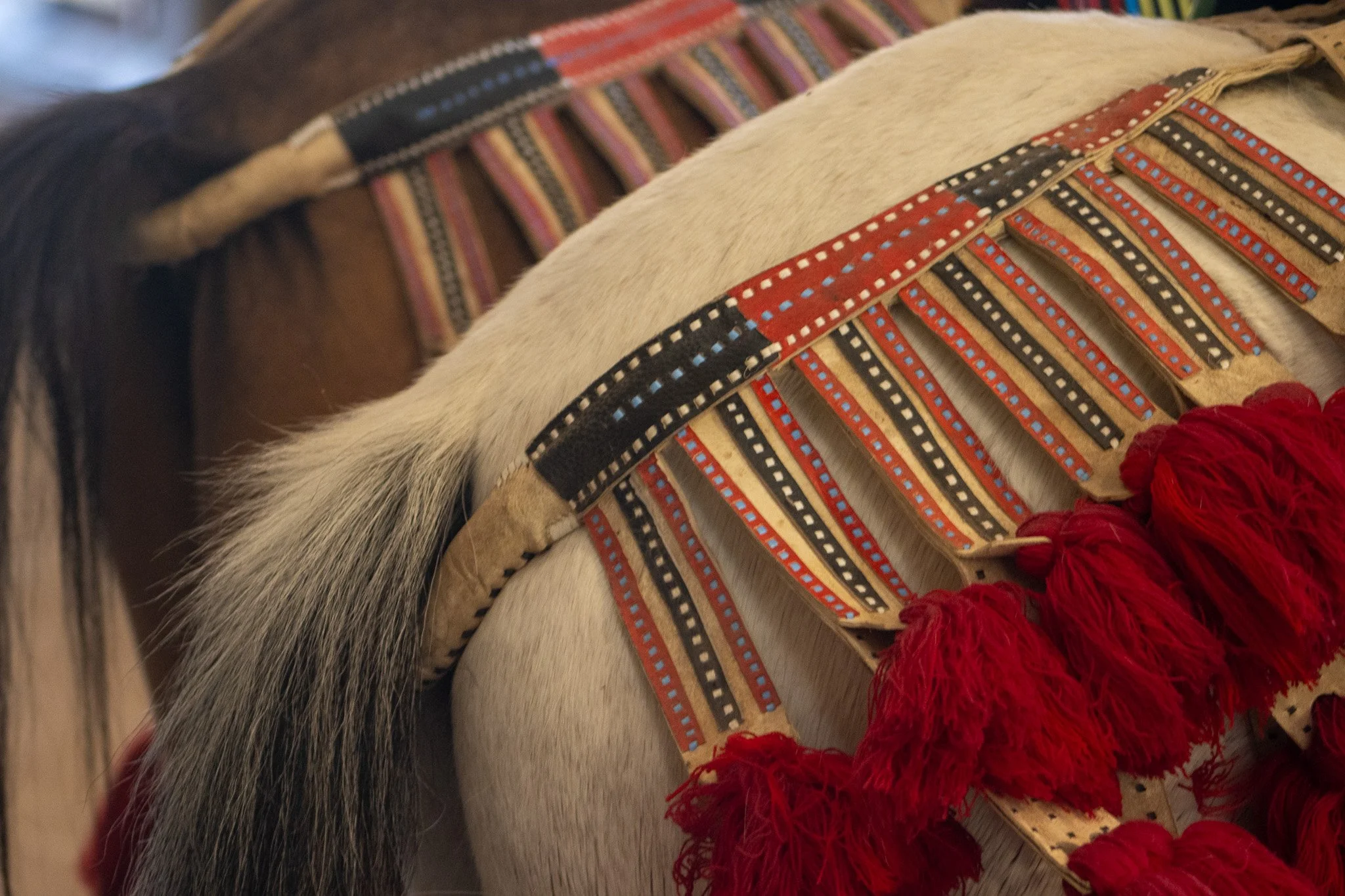
Some performances resemble jousting, with riders demonstrating mounted control and skill. The use of richly decorated saddles, coloured fabrics and tassels creates a distinctive visual culture. The historical relationship between these displays and military horsemanship is plausible, although the precise origin of the practice requires further research.
Saint George's feast days also provide an important context for equestrian imagery. As one of Ethiopia's most important saints, he is frequently represented mounted on a white horse, defeating a dragon. His imagery is associated with protection, victory and religious devotion.
Other regional celebrations incorporate horseback riding, particularly in communities where horses remain central to local identity. The Awi Agew horse culture study documents riding performances at annual religious celebrations, including gugs displays.
These examples demonstrate that horses in Ethiopia are not exclusively working animals. They continue to occupy a role in public ritual, religious identity and the transmission of local equestrian knowledge.
Principal sources
Kebede (2023), A Short History of Awi Agew Horse Culture.
Taylor & Francis Online
The Negative Cultural Impact of Tourism and Its Implication on Sustainable Development in Amhara Regional State (2023).
Taylor & Francis Online
British Museum, Painting of a Religious Procession.
Google Arts & Culture
The Kundudo horses
The Kundudo horses occupy a distinctive place in Ethiopian equine history. They are a small feral population living on Mount Kundudo in eastern Ethiopia, near the historic city of Harar. Their isolation, unusual setting and uncertain origins have made them an important subject for genetic and conservation research.
Unlike Ethiopia's domestic horse populations, which are maintained by rural households and pastoral communities, the Kundudo horses have lived in a feral state. They occupy the high-altitude plateau of Mount Kundudo, an isolated mountain landscape characterised by grassland and seasonal grazing.
Their precise origin remains uncertain. One widely discussed hypothesis connects their ancestors with the sixteenth-century Abyssinian–Adal War, which took place between 1528 and 1560. Horses may have been abandoned or escaped during this period of military conflict. However, no documentary evidence conclusively establishes this connection.
A 2021 study by Kefena and colleagues examined mitochondrial DNA from native Ethiopian horse populations, including the Kundudo population. It found evidence of genetic differentiation, consistent with the geographical isolation of these animals. The authors emphasised that their exact historical development remains poorly documented.
The Kundudo population experienced a dramatic decline during the twentieth and early twenty-first centuries. A conservation report by Abdurazak Sufiyan documented a population of only seven animals in 2015. Through local conservation initiatives, this increased to 24 in 2020, 27 in 2021 and 31 in 2022. These figures are historical survey estimates, not a verified count for 2026.
The principal threats identified include inbreeding, limited conservation resources, competition for grazing and encroachment by domestic livestock. Their small population size also creates significant reproductive and genetic risks.
The conservation response has involved cooperation between regional environmental authorities and the Ethiopian Biodiversity Institute. Protection measures have included the appointment of guards, community awareness programmes and efforts to maintain the horses within their original mountain habitat.
The Kundudo horses are particularly important because they represent a rare example of a feral equine population in Africa. Their significance lies not simply in their apparent wildness, but in their potential to preserve a distinctive genetic and historical resource.
Further genetic sampling, documentary research and sustained population monitoring are necessary to establish their origins and long-term conservation requirements.
Principal sources
Kefena et al. (2021), Genetic Diversities and Historical Dynamics of Native Ethiopian Horse Populations.
PubMed Central (PMC)
Abdurazak Sufiyan (2022), Kundudo Feral Horse: Trends, Status and Threats and Implication for Conservation.
Alien Mammals in the Afrotropical Region and Their Impact on Vertebrate Biodiversity (2025).
MDPI