We’ve been walking steadily uphill, through an ancient forest and up a mountain for the last five hours. I was expecting a quick one hour walk, not this. We are totally unprepared, its raining, icily cold, and we are clambering over what seems like endless ridges. Every time I ask how much further-like an annoying toddler- I get told its only another 20 minutes away. The third time this happens, and as we crest a hill only to see endless more hills ahead of us and no sign of any horses, I very nearly burst into tears.
To clarify, I am not generally a weeper, but the relentlessness of this, and the reality vs expectation is my undoing. We drove up to the forest, and were expecting to drive quite a way further but our driver decided he didn’t want to risk his car on slidey mud, so he decanted us. We then had to hike (for five hours). I like a good hike, on a good day, and yes, this place is eye-wateringly beautiful, but we have a whole day of shooting ahead and I am already frozen, blistered and sore and we are still nowhere near the bloody horses. So I have some Haribo and a sit down and then we carry on.
And then, that last hill becomes a fairytale.
We are joined by people, girls in white dresses and bright smiles, boys in their sunday best suits, men and women in Oromo traditional dress, and all of them, all of them, carrying bunches of small yellow flowers- the Meskel flower which only appears for a few weeks in spring and covers the highlands in a carpet of sweetly scented yellow. We walk alongside the procession of people and as we approach the plateau we walk through a small grove of trees. Along one side of the path is a towering bank of flowers, where everyone leaves their bunch. This is an offering to the mountain, a thank you for spring, part of the larger thanksgiving of Irreecha, and it is one of the most beautiful things I have ever seen. There is a quiet festiveness in the air, but it is paired with a reverence and such powerful, dignified, beautiful faith.I struggle to put into words what it felt like walking through there. Flowers and smiles and a rainy forest and stormy skies, a horse suddenly behind you decorated in pompoms and colour.
Irreecha is one of the most important cultural celebrations of the Oromo people, Ethiopia’s largest ethnolinguistic group. Traditionally associated with thanksgiving to Waaqa, the Creator, it marks the transition from the long rainy season towards Birraa, the season of renewal and abundance.
It is a celebration of gratitude for life, peace, family, livestock and the land's capacity to sustain its people. Across Oromia, Irreecha brings communities together through prayer, song, traditional dress and shared celebration. We happen to be in an area that also celebrates with a very special equestrian tradition- Gugs.
The game of Gugs
The mountain was shrouded in rain when we arrived at Mogle. Clouds moved across the sky, the ground was wet beneath our feet. Against this dramatic landscape, the horses stood out: beautifully decorated in reds and yellows and greens and pinks. Tethered to small cedar trees, they stood in little clusters like exotic fruit. They are so proudly turned out these horses, they would put British Pony Club to shame. Immaculately groomed, with very intricate tail plaiting, they are caparisoned in tassles and embroidered cloth. Their bridles serve double functions, one cheekpiece holding the bit and the other forming a halter, what I really liked was the minute a horse had finished being ridden, the bit and reins were removed straight away. Thoughtful towards the horse, which is often not the case.
The riders too, are beautifully turned out, many in the traditional Oromo colours; white, black red and green on an embroidered nehru-collared jacket. I see brightly polished suit shoes step into stirrups, headscarves being wound around foreheads. This is a proud display of horsemanship and a little insight into the immense, diverse world of Oromo equestrian culture.
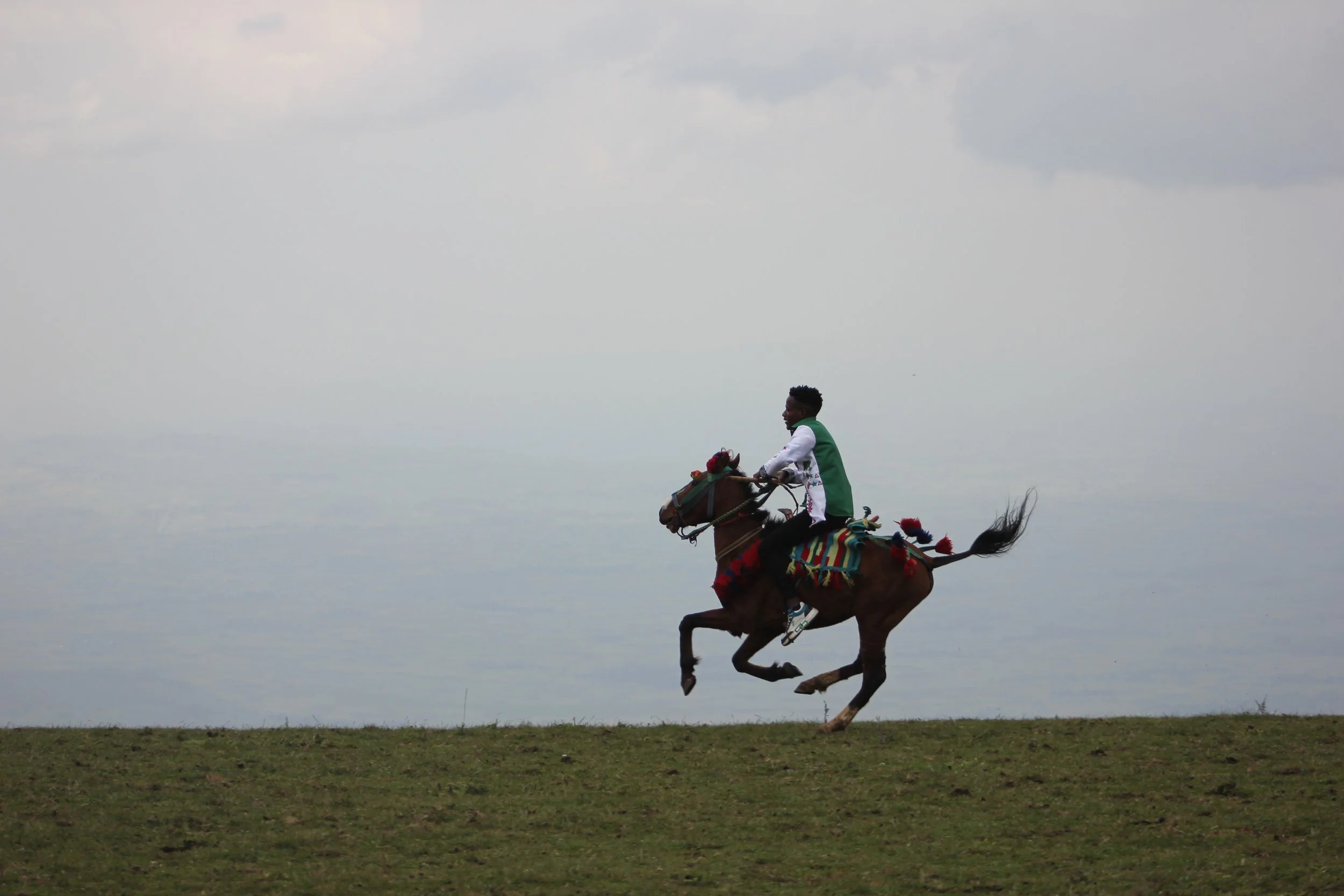
The game of Gugs was the reason we had come. Watching this tradition unfold offered a glimpse of a horse culture that deserves to be documented on its own terms and in so much more depth. Gugs is reminiscent of a cavalry excercise and seems to have roots in just that, although I couldn’t get a clear answer on its origins. Part of its heritage is The Gadaa System: In Oromo culture, the traditional socio-political system dictated that military defense was a collective civic responsibility. Every young man capable of acquiring a horse was trained from adolescence to become a fluid, highly mobile cavalryman, Gugs is a game of chaser and escapee, players pair up or divide into opposing teams. One rider acts as the chaser, pursuing the opponent at a full gallop while attempting to hit them or their shield with a large wooden stick (representing a spear) then the sticks are thrown to the ground and theb roles reverse. This all takes place at full speed on a mountain plateau.
For me, these are precisely the moments that make the FARAS project meaningful. Across Africa, horses occupy different places in the lives of the communities around them. They may be essential to work and travel, markers of status, companions, or central figures in ceremonies and sporting traditions.
Each context tells a different story about the people and the animals who share it.
Watching the event against the mountain weather inspired awe. It was timeless and vast and somehow a journey back in time, a game that has been ridden the same way for generations, in the same place. The hills were crowded with spectators. The little horses, their decorations and the people assembled around them seemed all the more vivid against the grey sky and the wet landscape. The highlands were not a backdrop separate from the event; they were part of the experience, a sort of dramatic stormy backdrop to a very colourful celebration.
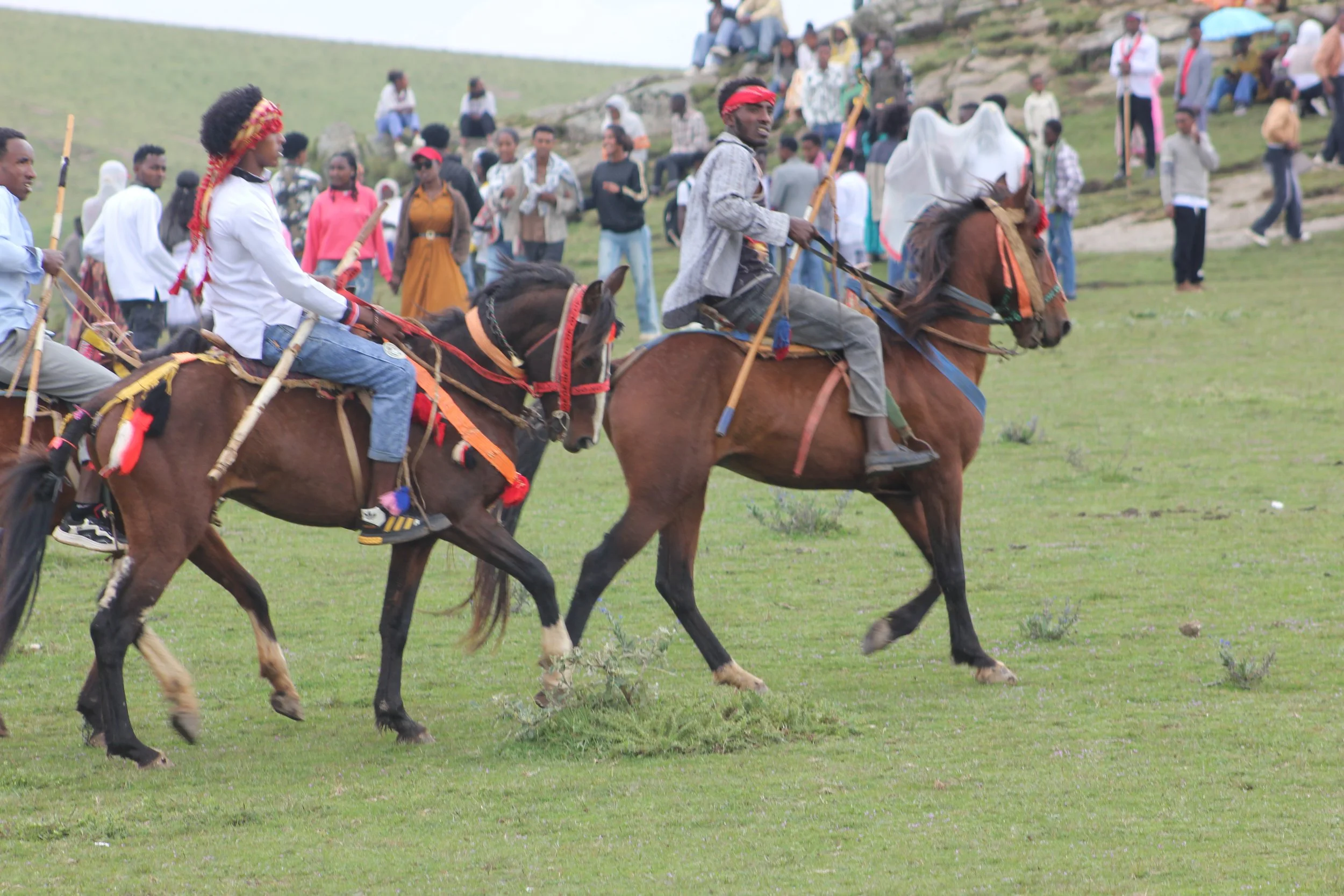
It was a reminder that traditions do not exist in isolation from the places that sustain them. They belong to particular landscapes, communities and histories. I am drawn to these encounters because they reveal something that a portrait of a horse alone cannot: the wider world in which the animal holds so much meaning.
FARAS is an ongoing photographic project exploring the horse cultures of Africa and the relationships between people, animals and land. Its chapters follow these relationships across distinct regions, each with its own traditions, landscapes and equestrian histories.
Our work in Lesotho brought us into the world of the Basotho pony and the horsemen of the mountain kingdom. In Ethiopia, the story is different, shaped by the country's own diverse communities and traditions.
We left with photographs and memories of decorated horses, a mountain under rain, and a gathering centred on a tradition we had travelled to witness. One day cannot tell the whole story of Oromo horsemanship, nor can a single encounter explain the full significance of Gugs. But it can open a door, and give us a reason to look more closely.
Maybe part of documenting a culture is simply being there, watching carefully and recognising that there is still so much to learn.
FARAS — documenting the living horse cultures of Africa.
