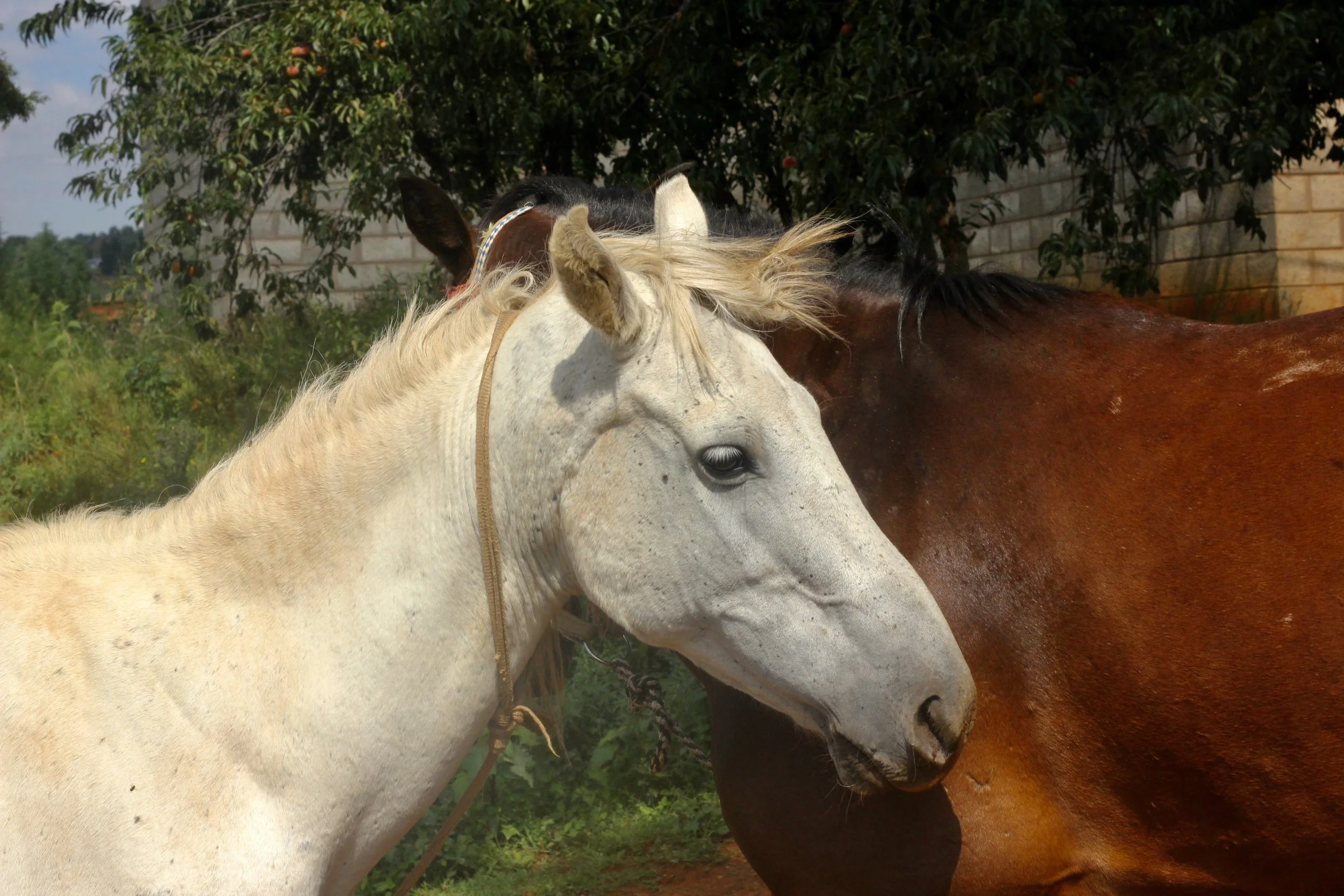
The Basotho pony is not flamboyant.
It does not have the theatrical suspension of a warmblood or the commanding presence of an Arab. It is compact, small, muscular and economical. Made for survival rather than spectacle, it has hooves of titanium and an attitude of can do, will do.
Developed in the highlands of Lesotho, this pony descends largely from Cape Horse bloodlines, shaped over generations by altitude, cold, rock, and necessity. There is no excess on these horses, no decorative flourish, everything about them is purposeful.
They climb where vehicles cannot. They cross mountain passes in snow and dust. They carry shepherds wrapped in thick Basotho blankets, moving across ridgelines that look, to the uninitiated, frankly impossible.
They are not luxury animals. They are infrastructure. Most of these herdsmen could not survive up here without them.
In Lesotho, the horse is not sport. It is not leisure. It is transport, status, livelihood, inheritance, and sometimes the only reliable connection between one village and the next. In a country where much of the terrain sits above 1,800 metres, the Basotho pony is not romantic folklore, it is daily life.
And yet.
Watch a horseman crest a ridge at sunset and I challenge you to tell me there is no poetry in it.
There is something ancient in the silhouette: blanket flaring, pony stepping carefully along a cliff edge, sky opening endlessly behind them.
It deserves reverence. This small, stoic pony deserves reverence.
The Basotho Pony developed from the Cape Horse, a population formed at the Cape after the introduction of horses by the Dutch East India Company in the seventeenth century. The original horses brought to the Cape included animals of Javanese origin, with Persian and Arabian influences, and were subsequently mixed with other European and oriental horses. Over generations, this heterogeneous Cape population became adapted to southern African conditions. From this stock emerged several regional horse types, including the animal that would eventually become the Basotho Pony.
There was therefore never a single moment when the Basotho Pony was bred. It was shaped gradually through movement, selection and environment.
Horses began entering the territory that became Lesotho in the early nineteenth century. Sources differ over the precise route and date, but by approximately 1825 horses were established among the Basotho, during the formative period of the kingdom associated with King Moshoeshoe I. Some accounts describe horses being captured from neighbouring Zulu groups and later acquired from Boer settlers; other historical accounts emphasise the movement of Cape horses into Basutoland. What is clear is that horses became increasingly important during the nineteenth-century consolidation of the Basotho state.
This was a period of extraordinary political upheaval in southern Africa.
King Moshoeshoe emerged as a powerful leader during the wars and migrations of the early nineteenth century, eventually establishing his stronghold at Thaba Bosiu. He brought together diverse communities seeking protection and built a political order that would become the Basotho nation. Horses became part of this new society alongside cattle, firearms and systems of allegiance.
The horse changed what was possible.
A mounted man could travel across the mountains faster than a person on foot. He could carry supplies, communicate between settlements, herd livestock and participate in warfare. Horses therefore became woven into the political and military landscape of the emerging Basotho state.
By the nineteenth century, horse ownership had become extraordinarily widespread. One historical study describes the relationship between the growth of Moshoeshoe's kingdom and the increasing ownership of horses, while contemporary accounts came to associate Basutoland with mounted riders. The phrase ‘nation of horsemen’, often used today to describe Lesotho, has its origins in this history, although historians caution against reducing Basotho society to such a romantic shorthand.
The horse itself was changing too.
The mountains of Lesotho imposed their own form of selection.
Lesotho is a high-altitude country, with much of its terrain characterised by steep slopes, rocky ground, cold winters, snow and extensive mountain grasslands. Horses living and working in this environment needed to survive on variable grazing and negotiate difficult surfaces. Over generations, the animals best suited to these conditions were retained and bred.
The result was a horse known for hardiness, endurance and sure-footedness. The Basotho Pony is small, but its size is part of its usefulness. A compact horse is easier to feed and manage in a difficult environment, while its relatively light body makes it well suited to steep mountain paths.
Its reputation came not from elegance but from performance.
The Basotho Pony could climb, descend, carry and endure. It became capable of travelling long distances over rough ground while carrying a rider and equipment. Local sources also describe additional lateral gaits known as the triple and pace, adding to its usefulness as a riding animal.
This is important because the Basotho Pony has sometimes been judged according to imported ideas of what a horse should look like.
Its body was not designed for a European show ring. It was designed for Lesotho.
The distinction becomes especially important when considering what happened to the breed at the end of the nineteenth century.
By then, the Basotho Pony had acquired a formidable reputation beyond Lesotho. During the Anglo-Boer War of 1899–1902, enormous numbers of Basotho horses were purchased for military use. One account estimates that as many as 30,000 Basotho Ponies were used as remounts during the conflict. The demand was so great that some of the finest breeding animals, particularly stallions, were removed from the country.
The war therefore became a turning point.
The very qualities that had made the Basotho Pony valuable, endurance, hardiness and the ability to travel over difficult terrain- contributed to its depletion.
The best animals were taken. Many were not coming back.
By the early twentieth century, the breeding population had been severely weakened. Export demand continued to remove good animals, while uncontrolled crossbreeding introduced Thoroughbred and other bloodlines in attempts to improve the pony according to external ideas of quality. A severe blizzard in 1902, combined with poor nutrition and management, further damaged the population.
The paradox was profound. The Basotho Pony had become famous because it was perfectly adapted to its environment, and then the demand for that very adaptation helped undermine the population that had produced it.
Throughout the twentieth century, concerns grew over the deterioration of the breed. By the 1950s, the Basotho Pony was considered to be facing severe decline. Government and international programmes subsequently attempted to rebuild the population and recover its characteristic qualities. In 1978, Lesotho and Ireland established the Basotho Pony Project, leading to the creation of a National Stud Farm at Thaba-Tseka, community breeding centres and extension programmes. Sadly this seems to no longer be in operation.
This history introduces another layer to the Basotho Pony: the question of who decides what the breed should become.
The twentieth-century conservation programmes were intended to save the pony, but they also involved selective breeding, line breeding, crossbreeding and the introduction of outside bloodlines. Arab horses from Egypt and Connemara ponies from Ireland were incorporated into improvement programmes. The objective was to strengthen the population while preserving desirable characteristics such as stamina, temperament and hardiness.
Conservation, in other words, did not mean simply returning to an untouched past. There was no untouched past to return to.
The Basotho Pony itself is a product of cross-cultural movement. Its ancestry reaches back to horses brought to the Cape from overseas; its development took place within Basotho society; its physical form was shaped by the mountains; and its later history was influenced by colonial trade, military demand and formal breeding programmes.
It is a distinctly African horse, but not an ‘indigenous’ horse in the simplistic sense of having existed in southern Africa before horses arrived with Europeans.
That distinction matters.
The Basotho Pony is better understood as a locally evolved African horse population: an animal whose ancestry is international but whose character was created in a particular African landscape and through generations of local use and selection.
Its genetic history reinforces this complexity. Blood-typing research has found the Basotho Pony to be closely related to other southern African descendants of the Cape Horse, rather than belonging neatly to one distant imported breed.
The horse therefore belongs to a wider southern African equine family.
But it became something distinctly Basotho.
Perhaps nowhere is this more apparent than in the relationship between horse and rider.
In the Lesotho highlands, the rider is often wrapped in a Basotho blanket, mounted on a compact horse and moving through enormous expanses of rock and grass. The image has become one of the defining visual representations of Lesotho. Yet beneath the iconic image is an entirely practical relationship. The horse carries the rider into places where other forms of transport struggle to go.
For rural communities, this remains significant.
Horses continue to provide transport in mountainous areas and can carry agricultural goods and supplies. Trekking has also developed into an important tourism activity, creating an economic use for the breed beyond its traditional role. The Basotho Pony therefore survives in a landscape where the modern and the traditional exist beside one another.
The Basotho Pony has already survived several transformations: the formation of the Basotho kingdom, nineteenth-century warfare, colonial expansion, the mass export of horses during the Anglo-Boer War, twentieth-century crossbreeding and attempts at formal conservation. Its history is not one of simple decline. It is a history of adaptation.
And perhaps that is the defining characteristic of the horse itself.
The Basotho Pony is small because the mountains do not require size, it is sure-footed because the ground demands it. It is hardy because the climate allows no alternative, it is enduring because distance is part of life.
And it remains deeply associated with the people of Lesotho because, for almost two centuries, the horse has been part of how they have moved through their country. There is something fitting about the fact that the Basotho Pony does not dominate the landscape, it simply belongs to it.
Against the vast mountains of Lesotho, the horse can appear almost insignificant, a small dark figure moving along a ridge, a rider disappearing into the highland mist. Yet for the people who depend upon it, the scale is reversed. The mountain may be enormous, but the horse is what makes the mountain traversable.
The Basotho Pony is therefore more than a breed, it is the product of a landscape and a people, shaped by history but never entirely defined by it.
Its story begins with horses brought across oceans and continues through the mountains of Lesotho. Between those two points lies a history of migration, warfare, trade, adaptation, loss and survival.
BASOTHO PONY :
Origin
Developed in Lesotho
Adapted to high-altitude terrain (most of Lesotho sits above 1,800m)
Bred primarily for endurance, sure-footedness, and resilience
Average Height
Typically 13.2 – 14.2 hands (137 – 147 cm)
Some individuals slightly smaller or larger depending on blood influence
Compact, strong bone, deep chest
Build & Conformation
Short-coupled, muscular body
Strong, well-developed hindquarters
Hard, durable hooves
Thick winter coat for mountain climate
Intelligent, alert expressionGaits
Walk: Energetic, ground-covering
Trot: Active, economical rather than extravagant- some of them also triple like the Icelandic horses
Canter: Balanced and efficient. Some triple and pace.
Known for exceptional sure-footedness on steep, rocky terrain
Bred for stamina over suspension;function over flourish
ColoursCommon colours include:
Bay, Brown, Chestnut, Grey, Black. Less common but present: Roan, Dun
Temperament
Hardy and resilient
Intelligent and independent
Calm but bold in difficult terrain
Strong work ethic
Breeding History
Descended largely from the Cape Horse of Southern Africa
Influenced by:
Arabian bloodlines (via early colonial imports)
Thoroughbred influence
Various European horses brought to the Cape in the 17th–19th centuriesNatural selection played a significant role; harsh climate and mountainous terrain shaped durability
Historically bred by Basotho horsemen for utility, not show
Traditional Use
Mountain transport
Herding livestock
Rural commuting between villages
