LESOTHO RESEARCH
The horses of Lesotho
The horse became an important part of Basotho society during the nineteenth century, particularly during the formation of the Basotho kingdom under Moshoeshoe I. Its adoption coincided with a period of political instability, territorial conflict and the consolidation of communities in the mountainous region that became Lesotho.
Horses were introduced into the wider Cape region during the seventeenth century by the Dutch East India Company. The Cape Horse, which subsequently developed from imported and locally crossed stock, became an important foundation for several southern African horse populations. Horses reached the territory of present-day Lesotho during the early nineteenth century. Historical accounts cited by the Lesotho Ministry of Agriculture place their arrival at approximately 1825, although the precise routes and circumstances of introduction remain debated.
The horse acquired considerable military importance during the nineteenth century. Mounted mobility provided advantages in reconnaissance, communication, raiding and the movement of armed men across difficult terrain. Moshoeshoe's kingdom developed during the period of the Lifaqane, when warfare and population displacement transformed much of the interior of southern Africa. Horses consequently became associated with both political authority and the practical organisation of military power.
By the late nineteenth century, the Basotho Pony had developed a reputation beyond Lesotho. Its reputation was particularly strengthened during the Anglo-Boer War of 1899–1902, when substantial numbers were purchased by the opposing military forces. The FAO's historical account estimates that as many as 30,000 of the best horses, particularly stallions, were sold during this period. The removal of valuable breeding animals subsequently contributed to the deterioration of the domestic breeding population.
Equestrianism, however, was never exclusively military. Horses became fundamental to rural transport, livestock management, agricultural work and communication between isolated mountain settlements. In areas where roads were limited or inaccessible, the pony provided a practical means of moving people and goods. Horse ownership also acquired social significance, with animals functioning as markers of status, wealth and masculine identity.
The horse continues to occupy a distinctive position in Basotho cultural life. It appears in national imagery, traditional praise poetry, social gatherings and competitive racing. Sandra Swart's research, published in Riding High: Horses, Humans and History in South Africa (2010), examines how the horse became embedded in Basotho ideas of identity, masculinity and national belonging.
The historical relationship between the Basotho and the horse is therefore best understood as an interaction between military adaptation, environmental necessity, economic activity and social identity.
Principal sources
Sandra Swart (2010), The Empire Rides Back: An African Response to the Horse in Southern Africa, in Riding High, Wits University Press.
Riding High+1
Tamolo A. Lekota, The State of the Basotho Pony in Lesotho, FAO.
Tamolo A. Lekota+1
Motlatsi Thabane (2023), History of Lesotho, Oxford Research Encyclopedia of African History.
Oxford Academic
The Basotho Pony
The Basotho Pony is an indigenous southern African horse type developed in the mountainous environment of Lesotho. Its characteristics reflect a combination of inherited ancestry, environmental selection and generations of practical use. Although commonly described as a distinct breed, its historical development involved considerable variation and periods of uncontrolled crossbreeding.
Its foundation stock is generally associated with the Cape Horse, itself descended from imported horses brought to southern Africa during the colonial period. The Cape Horse had diverse ancestry, including Javanese, Arabian and Persian influences. The Basotho population developed through subsequent selection in the highlands, where endurance, soundness and sure-footed movement were particularly advantageous.
The breed is relatively small, compact and economical in its physical requirements. Its traditional type is characterised by a strong body, sloping shoulder, substantial hindquarters, relatively fine limbs and hard, rounded hooves. The hooves are especially important in mountainous terrain, where horses regularly negotiate rocky tracks and steep gradients. Its ability to travel long distances over difficult ground is one of its most consistently documented characteristics.
The FAO identifies several adaptations associated with the traditional Basotho Pony, including tolerance of temperature extremes, the ability to maintain condition on variable grazing, strong hoof walls and good endurance. The animals are also described as intelligent and generally docile. A particularly interesting feature is the triple or tripling gait, a lateral two-beat movement reported in the breed. This is distinct from the conventional diagonal trot.
Genetically, the available research requires some qualification. Cothran and van Dyk's 1998 study examined seven blood-group and ten biochemical genetic loci in the Basotho Pony, Nooitgedacht and Boerperd. The Basotho Pony demonstrated the lowest observed heterozygosity of the three populations examined. The authors also found that these southern African populations were genetically more similar to one another than to several other domestic horse breeds. These results should not be confused with a modern whole-genome analysis.
The breed experienced serious deterioration during the twentieth century. The export of valuable breeding animals during the Anglo-Boer War, subsequent climatic hardships and uncontrolled crossing with imported horses contributed to the loss of traditional characteristics. A Basotho Pony improvement programme was consequently established with Irish assistance, including the introduction of Arabian and Connemara blood.
Historically, the pony has been used for transport, agricultural work, livestock herding, pack duties and racing. Today, it also supports trekking and tourism in rural communities.
The Basotho Pony is not simply a small mountain horse. It represents a locally adapted equine population whose defining qualities emerged through the interaction of genetics, husbandry and a demanding physical environment.
Principal sources
Lekota, The State of the Basotho Pony in Lesotho, FAO.
Tamolo A. Lekota+1
Cothran & van Dyk (1998), Genetic Analysis of Three South African Horse Breeds, Journal of the South African Veterinary Association.
JSAVA Journals+1
The Basotho Pony: A Breed Improvement Program in the Highlands of Lesotho (2018).
PMC
The Basotho Blanket
The Basotho blanket is one of the most recognisable elements of Lesotho's material culture. Although now strongly associated with national identity, its origins lie in the nineteenth-century introduction of commercially manufactured woollen blankets into southern Africa. Its subsequent adoption by the Basotho illustrates how an imported commodity became integrated into local social practices and cultural identity.
Historical research indicates that European traders and missionaries brought manufactured blankets into the region during the 1830s. The precise story of their introduction remains uncertain. Several accounts describe a European visitor presenting a blanket to Moshoeshoe I, although the identity of the visitor and the circumstances of the exchange vary between versions. Anthropologist Tuulikki Pietilä notes that the historical evidence for these origin stories is incomplete.
Blankets gradually replaced animal-skin garments as an important form of clothing. Their practical value was particularly significant in Lesotho's cold, high-altitude climate. However, their adoption extended beyond protection from the weather. Blankets became associated with important stages of life, including marriage, childbirth, initiation and mourning. Particular designs and colours acquired social meanings, while the act of wrapping and covering became embedded in Basotho understandings of protection, continuity and identity.
Commercial production developed during the late nineteenth century. The trading company Fraser Brothers became influential in supplying blankets designed specifically for Basotho consumers. The Victoria England brand was introduced in 1897 to commemorate Queen Victoria's Diamond Jubilee. Production later became associated with Aranda Textile Mills in Johannesburg, which continues to manufacture and trademark Basotho blanket designs.
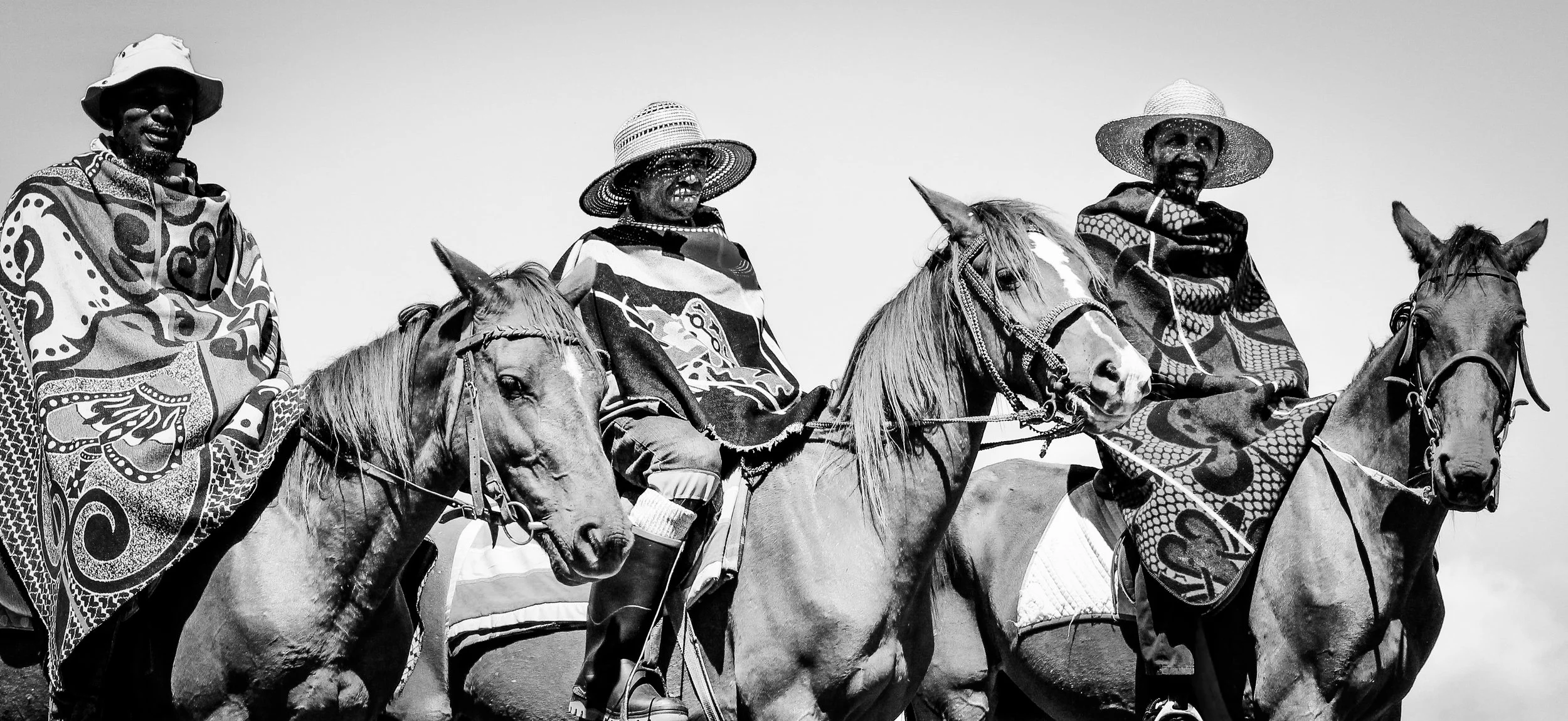
The relationship between blankets and equestrian culture is particularly significant in the visual representation of Lesotho. The image of the mounted Basotho horseman wearing a blanket is familiar in photography, tourism and national iconography. The blanket serves a practical purpose when riding in cold mountain conditions, providing warmth and protection. Its method of being wrapped around the body and secured at the shoulder also makes it compatible with traditional riding attire.
However, it is important to distinguish between the blanket's general cultural function and a specifically equestrian garment. The blanket was not developed exclusively for horsemen; it is worn across many social contexts. Its association with the mounted horseman reflects the historical integration of horses into everyday Basotho life.
The blanket and pony have consequently become mutually reinforcing symbols of Lesotho's cultural identity. Their association is not merely an aesthetic one: both are connected to the country's geography, history and social organisation.
Principal sources
Tuulikki Pietilä (2023), Basotho Blankets: Ownership and Appropriation, Journal of the Royal Anthropological Institute.
Wiley Online Library+1
Myrtle Karstel (1995), The Basotho Blanket, Borrowed but Traditional, National Museum research journal.
Journals
Gosiame Amy Goitsemodimo (2026), A Nation Wrapped in Tradition, National Museum Publications.
National Museum Publications+1
4. The King's Races and Basotho horse racing
Horse racing remains an important expression of contemporary equestrian culture in Lesotho. Unlike formal European racing, which developed around professional institutions, regulated tracks and established breeding industries, many Basotho race meetings retain a strong community-based character. They bring together horse owners, riders, spectators and local organisers, with the horse occupying a central position in both competition and social life.
Racing developed alongside the wider importance of the horse in Basotho society. Horses provided transport, supported agricultural livelihoods and became associated with male social status. Competitive racing offered owners an opportunity to demonstrate the speed, fitness and quality of their animals, while providing a public setting in which horsemanship and ownership could be recognised.
One of the better-documented contemporary racing centres is Semonkong, in the Maseru District. According to Semonkong Lodge, local races are organised by a community racing committee, with meetings taking place periodically during the winter months, subject to weather and track conditions. The surrounding mountainous landscape provides the setting for temporary racing courses rather than the permanent, purpose-built tracks associated with conventional racing industries.
The events commonly referred to in local tourism material as the King's Birthday races take place around the birthday celebrations of King Letsie III, whose birthday falls on 17 July. Independence Day celebrations around 4 October also provide an important occasion for racing. These events attract local competitors and spectators, with prize money contributing to the competitive significance of individual meetings.
The social dimension of racing is as important as the sporting one. Owners frequently ride their own horses, and spectators gather to support particular competitors. Betting and prize money can form part of the event's economy, while food, music and social gatherings extend the occasion beyond the race itself.
Racing also provides an interesting context for understanding changes in Basotho horse ownership. The traditional Basotho Pony remains important in rural transport and working life, but ownership of larger imported horses can carry considerable prestige. Anthropological research by Elizabeth A. Quinlan documents the relationship between horse ownership, status and local racing traditions in Lesotho.
The term King's Races should nevertheless be used carefully. Available sources document racing associated with the King's Birthday and national celebrations, but do not establish a single nationally standardised competition with a continuous historical record. The events are better understood as part of a wider network of community-organised racing traditions.
Principal sources
Semonkong Lodge, Horse Racing in Lesotho.
Semonkong Lodge+1
Elizabeth A. Quinlan, Marena a Lesotho: Chiefs, Politics and Culture in Lesotho, University of Cape Town research.
Open UCT
Sandra Swart (2010), Riding High, Wits University Press.
Riding High