NAMIBIA
The origins of the Namib horses: competing historical theories
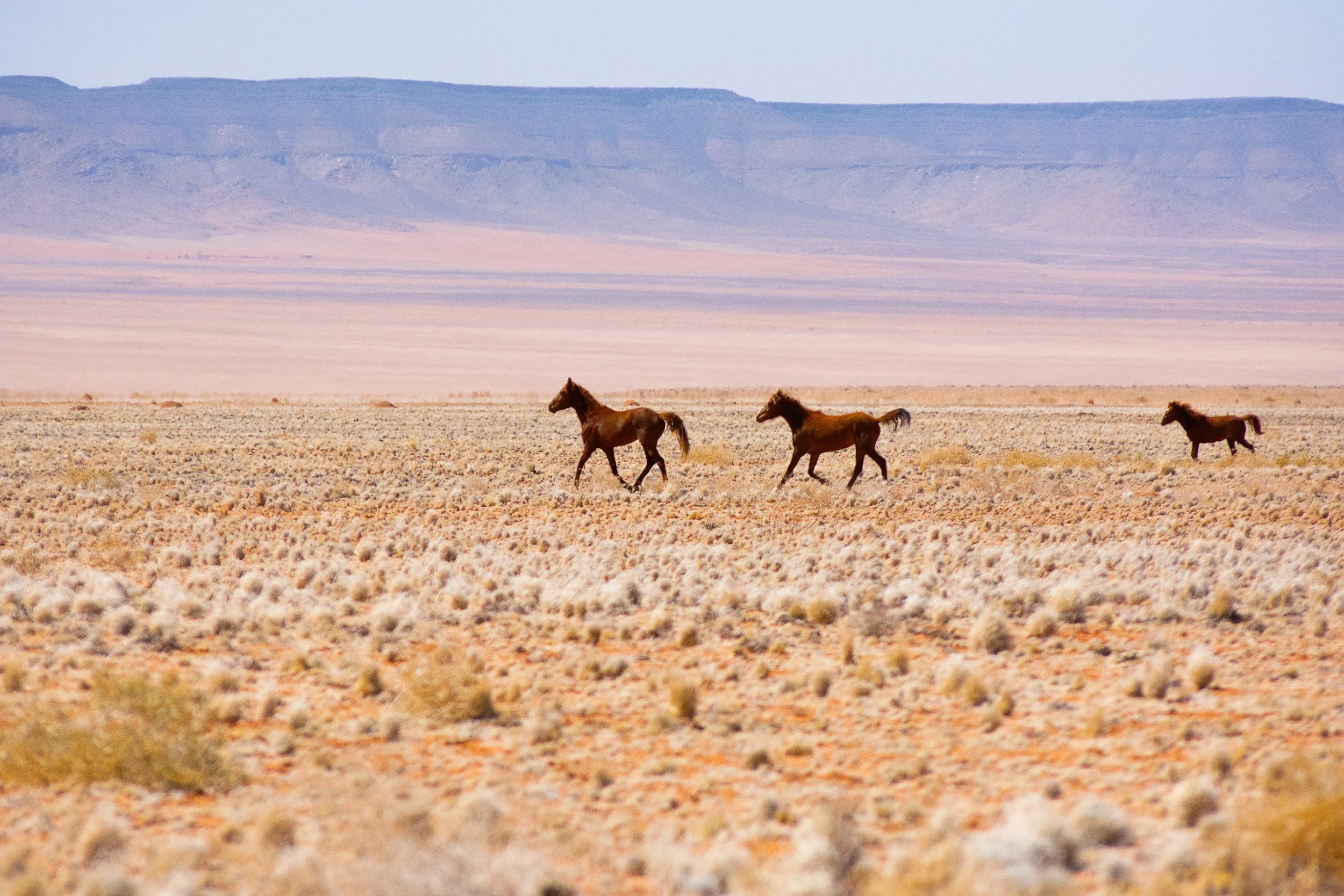
The Namib horses are a population of feral domestic horses living in the Garub area of southern Namibia, close to Aus and Lüderitz. Their presence in one of the world's driest environments has attracted considerable historical and scientific interest. Unlike the Przewalski's horse, they are not a genetically distinct wild species but descend from domestic horses introduced by humans.
Their precise origins remain contested. Several theories have emerged, each associated with the region's colonial, military and commercial history during the late nineteenth and early twentieth centuries.
One prominent theory connects the horses to the stud farm established by German officer Hansheinrich von Wolf at Duwisib. Von Wolf bred horses for the German colonial military, the Schutztruppe. Following his death during the First World War, the story developed that his widow released approximately 300 horses into the surrounding desert. However, this account is problematic. Duwisib is approximately 250 kilometres from Garub, and surviving farm records do not establish that such a release occurred. Historical accounts also indicate that reports of feral horses near Garub predate the suggested release.
A second theory associates the population with horses belonging to the German Schutztruppe. During the First World War, German military forces withdrew from parts of German South West Africa as South African forces advanced. Horses may have been abandoned, escaped or released during these movements.
A third explanation connects the horses to South African military forces stationed around Garub in 1915. Historical accounts describe approximately 10,000 South African soldiers and 6,000 horses in the area during the campaign against German colonial forces. Some animals may have escaped or been abandoned when military operations concluded.
Another theory proposes that horses from nearby breeding establishments, particularly the Kubub stud associated with Emil Kreplin, contributed to the population. Kreplin was involved in breeding horses for racing and commercial purposes.
The 2020 study Contested Conservation – Neglected Corporeality: The Case of the Namib Wild Horses, published in Geographica Helvetica, examines these competing histories and demonstrates how the horses' origins have become entangled with Namibia's colonial past and national identity.
Genetic research by Cothran, van Dyk and van der Merwe (2001) found that the sampled horses had relatively low genetic variation and showed their greatest similarity to Arabian-type horses among the breeds examined. However, this does not establish a single Arabian origin.
The most defensible conclusion is that the present population probably developed from several domestic horse lineages introduced into the Garub region. The exact contribution of individual military and civilian breeding populations remains unresolved.
Principal sources
Contested Conservation – Neglected Corporeality: The Case of the Namib Wild Horses (2020), Geographica Helvetica.
Cothran, van Dyk & van der Merwe (2001), Genetic Variation in the Feral Horses of the Namib Desert.
JSAVA
Namibian Ministry of Environment and Tourism, Management Plan for the Namib Wild Horses.
Ministry of Environment
The Namib horse: physical characteristics, behaviour and survival in the desert
The Namib horses are a population of feral domestic horses that have adapted to living in the exceptionally arid environment of the southern Namib Desert. Their habitat is characterised by limited vegetation, high daytime temperatures, low and irregular rainfall and significant seasonal variation in available water.
The horses occupy the Garub plains near Aus, within the wider Namib-Naukluft National Park landscape. Their continued presence in this environment has raised questions about the physiological and behavioural adaptations that allow domestic horses to survive under such demanding conditions.
Physically, the population displays considerable variation. Individual animals differ in height, body type and coat colour, reflecting their mixed domestic ancestry. Their overall appearance is generally that of medium-sized riding horses rather than a formally established desert breed. Some individuals exhibit relatively refined features, while others are heavier and more substantial.
Their behaviour is influenced by the availability of water and grazing. The population depends on the Garub water infrastructure, which has become a critical part of its survival. The horses congregate around the water supply and travel through surrounding grazing areas according to seasonal conditions.
A particularly important aspect of their ecology is their dependence on external water provision. The Namibian government's management plan explains that the horses require daily access to water and may need supplementary feeding during prolonged droughts. This challenges the popular description of them as completely self-sustaining wild horses.
Drought and predation have had significant effects on population dynamics. During the prolonged drought between 2015 and 2018, the horses experienced severe nutritional stress. Predation by spotted hyenas has also affected foal survival. The management plan documents a particularly serious period of predation beginning in 2013, when hyenas increasingly targeted foals and subsequently adult horses.
Population estimates have fluctuated considerably. The management plan recorded 77 animals at the end of May 2019, following earlier decades in which numbers were generally higher. These figures should not be presented as a current 2026 census.
Genetic research has identified extremely low genetic variation in the population. Cothran and colleagues examined 30 horses and concluded that the limited diversity was probably associated with a small founding population and subsequent population bottlenecks.
The Namib horses therefore represent a valuable case study in feral animal ecology. Their survival cannot be explained simply through an assumption of extraordinary desert hardiness. It depends on behavioural adaptation, access to managed water, grazing conditions and conservation intervention.
Principal sources
Namibian Ministry of Environment and Tourism, Management Plan for the Namib Wild Horses.
Ministry of Environment
Cothran, van Dyk & van der Merwe (2001), Genetic Variation in the Feral Horses of the Namib Desert.
JSAVA
Contested Conservation – Neglected Corporeality (2020).
Alien Mammals in the Afrotropical Region and Their Impact on Vertebrate Biodiversity (2025).
MDPI