Lesotho: The Horse and the Mountain
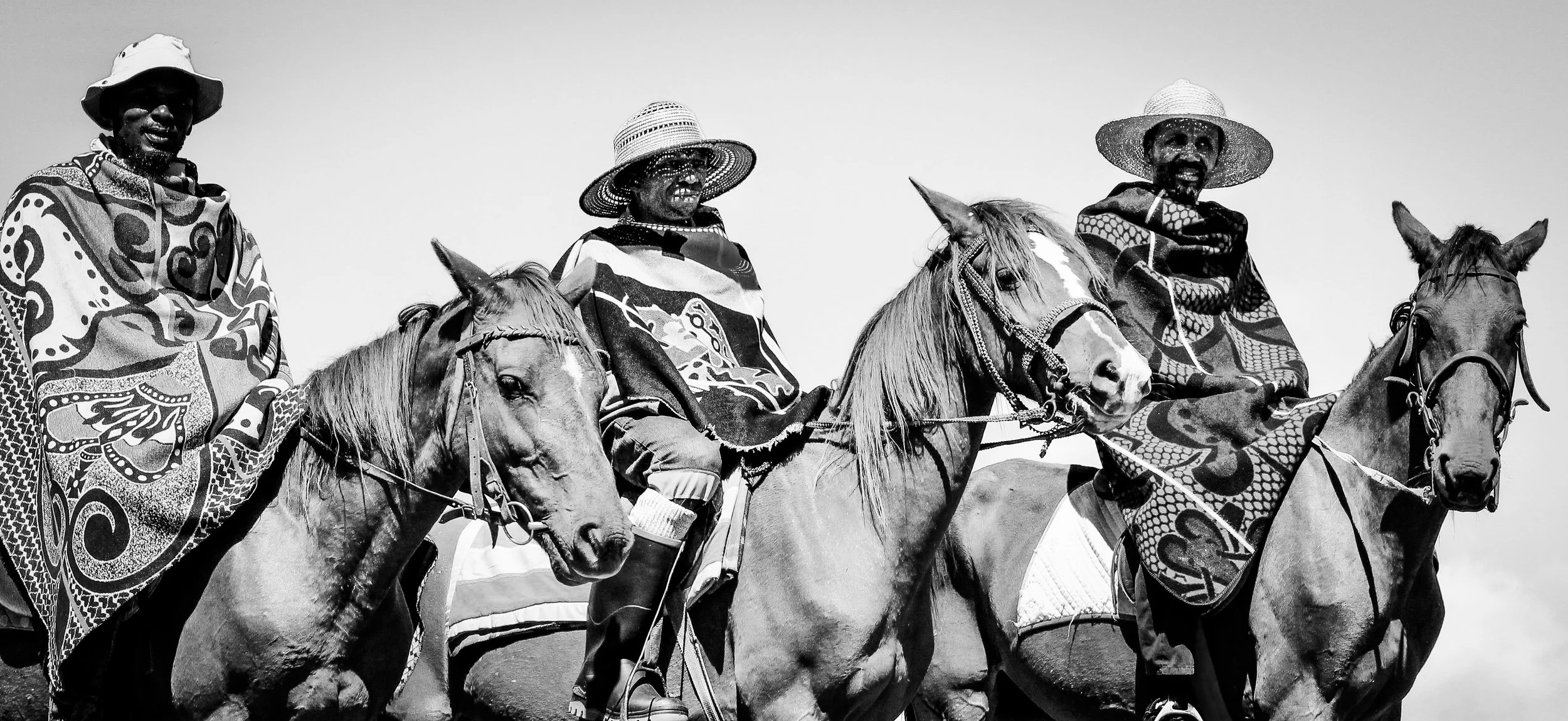
Horses arrived in the region that is now Lesotho around the 1820s, at roughly the same time that King Moshoeshoe I was consolidating the Basotho nation. One historical account says the earliest horses in Lesotho were acquired from neighbouring Zulu groups and later from Boer settlers; the horses themselves ultimately descended largely from the Cape Horse, whose ancestry included horses brought to southern Africa through the Cape.
And then something quite remarkable happened.
The horse fitted Lesotho.
The mountains, steep valleys, high altitude and difficult terrain made conventional transport extremely difficult. A small, hardy horse that could carry a person over mountain tracks was extraordinarily useful. Over generations, horses that survived and reproduced in those conditions became what we now recognise as the Basotho Pony.
But war and political upheaval accelerated the relationship enormously.
1. Why were they riding in the first place?
The early 19th century in southern Africa was an extraordinarily turbulent period, associated with the Lifaqane/Mfecane upheavals.
Moshoeshoe was building a new political community from groups who had been displaced by warfare and raiding. His mountain stronghold at Thaba Bosiu became the centre of the emerging Basotho kingdom.
Horses gave people a major advantage in this landscape.
A mounted person could:
travel much faster between settlements
move through the mountains carrying supplies
herd livestock over enormous distances
communicate between scattered communities
escape or respond rapidly to raids
patrol territory
carry weapons and supplies
move across terrain where wheeled transport was virtually useless.
So the horse wasn't a luxury. It became infrastructure.
And eventually, military infrastructure.
2. Moshoeshoe realised the military value of the horse
This is probably the most important part of the story for FARAS.
During the conflicts with neighbouring groups and, increasingly, Boer settlers, the Basotho encountered mounted opponents.
South African History Online records that after seeing mounted and armed opponents, Moshoeshoe decided to arm his own people and acquire horses.
That changes the interpretation of the Basotho horseman quite dramatically. He wasn't originally a romantic mountain cowboy. He was, in part, a mounted defender of a young nation.
The horse allowed Basotho fighters to respond quickly across a mountainous kingdom where infantry movement was slow.
And the mountains themselves made the combination particularly effective: the horse could take a rider into places where larger European horses and conventional military transport struggled.
3. The horse then became part of everyday Basotho life
This is where it becomes much more interesting than simply a military history.
By the 19th century, horses had become extraordinarily widespread.
One academic account of the Basotho Pony states that by the time of Moshoeshoe I, the population was considered essentially mounted. It also describes the pony as an essential means of transport and a beast of burden.
That's an extraordinary transformation in perhaps only a few generations.
The horse became useful for:
Herding → travelling → trading → communication → carrying goods → warfare → status → identity.
And because cattle were central to Basotho society, the ability to ride long distances while managing livestock was particularly valuable.
4. Why the Basotho Pony became so distinctive
This is one of my favourite parts of the history.
The Basotho didn't simply import one neat "breed" and continue breeding it unchanged.
The horse adapted to the country.
The FAO history traces the Basotho Pony back to the Cape Horse and describes the type as developing through natural selection. By the mid-to-late 19th century, Europeans were already recognising the Basotho Pony as a distinct type.
Think about what that environment demands:
High altitude.
Cold winters.
Snow.
Rock.
Steep slopes.
Long distances.
Sparse grazing.
The ponies that thrived were therefore the tough ones.
Small enough to be economical.
Strong enough to carry an adult.
Sure-footed.
Hardy.
Able to live largely off the landscape.
And crucially, comfortable in the mountains.
That is why the Basotho Pony became much more than an imported horse.
It became a horse of Lesotho.
5. Then came the Boer Wars and the horse's reputation exploded
By the late 19th century the Basotho Pony had become famous beyond Lesotho.
During the Anglo-Boer War (1899–1902), approximately 30,000 Basotho Ponies were used as remounts by the British army, according to the Journal of Animal Science.
That's huge. The irony is that the very qualities that had evolved through life in Lesotho's mountains made these ponies valuable to outside armies. But there was a downside.. Large numbers of the best animals were exported, contributing to deterioration of the breeding population within Lesotho.
By the mid-20th century the breed was in serious decline.
6. And this is where the modern horseman comes from
The contemporary image of the Basotho horseman wrapped in a blanket, riding a small pony through the mountains can look ancient.
But the history is more complicated.
The horse itself is relatively recent in Basotho history, roughly two centuries.
What makes the tradition feel ancient is that the horse became absorbed incredibly deeply into an existing mountain society.
It became associated with:
independence
mobility
livestock
masculinity
adulthood
mountain life
freedom
survival
national identity.
And the blanket and mokorotlo aren't costumes invented for tourists. They're part of a much wider Basotho material culture, while the horseman's appearance developed within that living society.
So when I photograph a Basotho rider today, I’m not really photographing "a traditional horseman" in the sense of someone preserving a frozen ancient custom. I am photographing the continuation of a relationship that grew out of the formation of the Basotho nation itself.
The Basotho did not inherit a horse culture. They built one.
